Buying guides
Portable e-readers: how to choose the right size, from 3.7 to 7 inches
How portable should your e-reader be? Pocket, phone-sized, 6-inch and 7-inch e-readers compared by screen area, text per page, weight and width, with picks for each.
By IKAWE · Published · 7 min read
IKAWE makes Moov, a pocket e-reader that appears in this guide; its specifications are IKAWE's own. Other readers' specifications come from makers' pages and the sources listed, checked on 19 October 2026. Screen areas are our calculations from published pixel counts and pixel densities.
Key takeaways
- E-readers come in four sizes: pocket (3.7–4.5 inches, 58–75 g), phone-sized (5.84–6.13 inches, 130–195 g), standard 6-inch and large 7-inch.
- A pocket reader shows a little under half the text of a 6-inch Kindle at the same font size; IKAWE Moov's 4.5-inch screen reaches half.
- Width decides portability more than screen size: pocket readers are 62–69 mm wide, narrower than most phones; phone-sized readers are 78–80 mm.
- Choose pocket if you'll only read when it's always with you; 6-inch if you read for long sessions at home or rely on library books.
In this article
The four sizes of e-reader
| Size | Screen | Weight | Examples | Where it goes |
|---|---|---|---|---|
| 3.7–4.5 inches | 58–75 g | Xteink X3, Boox Picco, Xteink X4 Pro, IKAWE Moov | Jeans or jacket pocket, the back of your phone | |
| Phone-sized | 5.84–6.13 inches | 130–195 g | PocketBook Q, Boox Palma 2 and 3 | Jacket pocket, small bag |
| Standard | 6 inches | About 170 g | Kindle, Kobo Clara BW | Bag |
| Large | 7 inches | About 200 g | Kindle Paperwhite, Kobo Libra Colour | Bag, bedside table |
How much text fits on each screen?
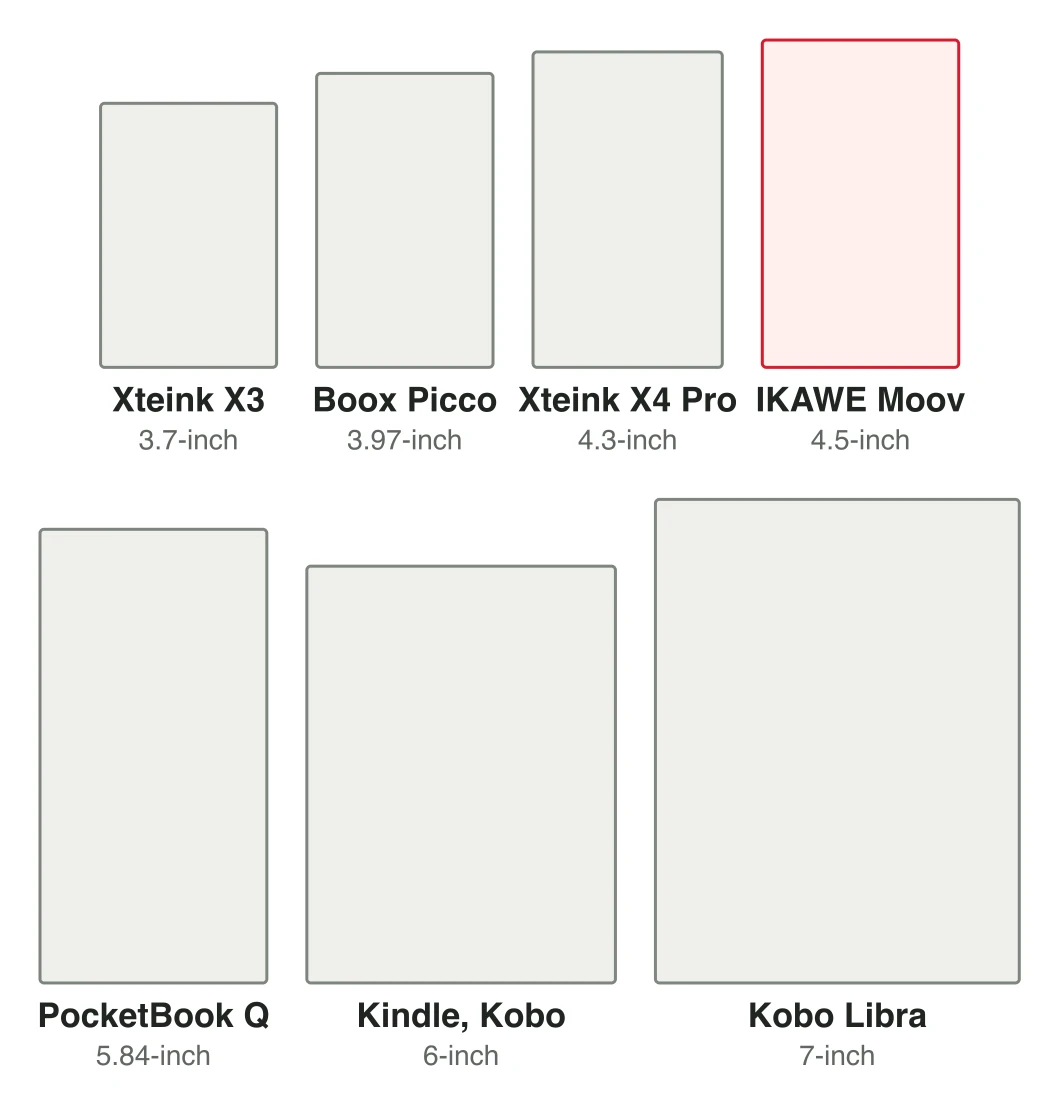
At the same font size and margins, the text on a page scales with the screen's area. Here's how much screen each reader has, compared with a 6-inch Kindle or Kobo:
- Kobo Libra (7-inch)137 %
- Kindle, Kobo Clara BW (6-inch)100 %
- PocketBook Q (5.84-inch)80 %
- IKAWE Moov (4.5-inch)50 %
- Xteink X4 Pro (4.3-inch)46 %
- Boox Picco (3.97-inch)40 %
- Xteink X3 (3.7-inch)36 %
Calculated from each panel's pixels and PPI. Screens with taller, narrower shapes fit slightly different numbers of lines and words.
So a pocket reader turns pages two to three times as often as a 6-inch reader at the same font size. Two things narrow the gap: a slightly smaller font (going from 10 to 8 point fits about 56% more text), and a sharper screen that keeps that smaller font crisp. That's why pixel density matters more on small readers; see 300 PPI e-readers explained.
Weight and width: what makes a reader portable
Weight decides whether you notice a reader in your pocket. Width decides whether it fits in a pocket at all, and whether you can hold it comfortably in one hand.
- Xteink X358 g
- Boox Picco58 g
- Xteink X4 Pro72 g
- IKAWE Moov75 g
- PocketBook Q130 g
- Boox Palma 2170 g
- Kobo Clara BW174 g
- Boox Palma 3195 g
- Boox Picco62 mm
- Xteink X363.7 mm
- IKAWE Moov66 mm
- Xteink X4 Pro69 mm
- Boox Palma 378 mm
- Boox Palma 280 mm
Phone-sized readers are about as wide as a large phone.
Pocket readers weigh less than a deck of cards and are narrower than most phones, so they slip into a jeans pocket or stick to a magnetic phone case. Phone-sized readers weigh more than twice as much and ride in a jacket pocket or bag, much like a second phone.
Pocket, phone-sized or 6-inch?
Pocket (3.7–4.5 inches)
Pros
- Always with you: 58–75 g, narrower than a phone
- Many attach to the back of your phone
- Physical page-turn buttons on most models
- From $69
Cons
- Less text per page: more page turns
- Most read DRM-free files only, not Kindle or library loans
- Small text needs a sharp screen
Phone-sized (5.84–6.13 inches)
Pros
- Nearly a 6-inch page in a narrow shape
- Some run Android apps (Boox Palma) or Libby (PocketBook Q)
- 300 PPI screens
Cons
- 130–195 g: more than twice a pocket reader
- Jacket-pocket rather than jeans-pocket size
- Higher prices, up to about $340
Standard 6-inch
Pros
- The most text per page for the weight
- Built-in stores and library loans
- Widely reviewed and supported
Cons
- Lives in a bag, not a pocket
- About 170 g
Choose by how you read
- Commuting and queues: a pocket reader you always carry beats a bigger one left at home. Physical page-turn buttons help when you're standing and holding on with one hand.
- Travel: any e-reader saves space over paperbacks. A pocket reader fits a jacket pocket on the plane; a 6-inch is easier for hours of reading.
- Reading in bed: look for a warm/cool front light; size matters less. See the smallest e-readers with a front light.
- Pool and beach: look for an IPX8 rating, which few small readers have. See is the Xteink waterproof?
- Library books: most pocket readers can't open Libby loans. A Kobo, Kindle or PocketBook Q can.
- Long sessions: a 6- or 7-inch screen with a larger font is more comfortable for hours at a time.
Our picks by size
IKAWE Moov
$99–129
- Screen
- 4.5″, 219 or 300 PPI
- Weight
- 75 g
- Width
- 66 mm
- Water
- IPX8 on Pro
Best for: a pocket reader with the most screen: 4.5 inches, half the area of a 6-inch Kindle.
Boox Picco
$99.99–109.99
- Screen
- 3.97″, 235 PPI
- Weight
- About 58 g
- Width
- 62 mm
Best for: the smallest reader with a light, if every gram counts.
PocketBook Q
€199
- Screen
- 5.84″, 300 PPI
- Weight
- 130 g
- Water
- IPX4
Best for: a phone-shaped reader with Libby, if you can wait for late 2026.
Kobo Clara BW
$159.99
- Screen
- 6″, 300 PPI
- Weight
- 174 g
- Water
- IPX8
Best for: 6-inch reading with the Kobo store and library loans.
Portable e-reader checklist
- Measure your pocket. Pocket readers are 98–114 mm tall and 62–69 mm wide.
- Check the light. Only some pocket readers have one.
- Check the charging. USB-C means one cable for everything; pogo pins mean a special cable to carry.
- Check sharpness. On a small screen, a higher PPI lets you read smaller text comfortably.
- Check the books. Pocket readers mostly read DRM-free EPUBs; if you rely on Kindle or library loans, go phone-sized or bigger.
- Check for buttons. Physical page-turn buttons make one-handed reading easier on the move.
The bottom line
See every pocket e-reader compared for the full list of readers under 5 inches.
Frequently asked questions
What is the most portable e-reader?
The Xteink X3 and Boox Picco are the smallest and lightest, at about 58 g. IKAWE Moov (75 g) is the most portable reader with a 4.5-inch screen, and Moov Pro adds 300 PPI and IPX8.
What is a pocket-size reader?
An e-reader with a screen under about 5 inches, small and light enough (58–75 g) to carry in a jeans or jacket pocket, such as the Xteink X4 Pro, Boox Picco or IKAWE Moov.
What size e-reader is best for travel?
If you'll read in short bursts, a pocket reader you always carry. For long flights and hours of reading, a 6-inch reader shows more text per page. Both beat a stack of paperbacks.
Is a 4-inch e-reader too small?
Not for most people, though you'll turn pages two to three times as often as on a 6-inch reader at the same font size. A sharper screen lets you use a smaller font comfortably, which helps.
How much text fits on a pocket e-reader?
About 36–50% of a 6-inch screen at the same font size, depending on the model. IKAWE Moov's 4.5-inch screen is about half the area of a 6-inch Kindle.
Will a pocket e-reader fit in my jeans pocket?
Most will: pocket readers are 62–69 mm wide and 98–114 mm tall, smaller than most phones. Phone-sized readers, at 78–80 mm wide, are a tighter fit.
Which portable e-readers work with library books?
The Kobo Clara BW and PocketBook Q have Libby built in, the Kindle works with US library loans, and Android readers such as the Boox Palma run the Libby app. Most pocket readers read DRM-free files only.
Are portable e-readers waterproof?
Few are. Among pocket readers, only IKAWE Moov Pro is rated (IPX8). The 6-inch Kobo Clara BW is IPX8 and the PocketBook Q IPX4.
Sources
- Xteink X3 product page
- Boox Picco product page
- Xteink X4 Pro product page
- IKAWE Moov Lite and Moov Pro
- The eBook Reader: PocketBook Q (26 Aug 2026)
- Good e-Reader: PocketBook Q is a phone-sized e-reader
- Boox Palma 2 product page
- Boox Palma 3 product page
- Kobo Clara BW product page
- Kobo Clara BW specifications
- TechRepublic: 2026 Kindle lineup and prices
- Amazon: Kindle (2024) specifications
- Amazon: Kindle Paperwhite (2026)
- Kobo Libra Colour specifications
Specifications and prices checked on October 19, 2026. Products change; check the maker’s page before buying.